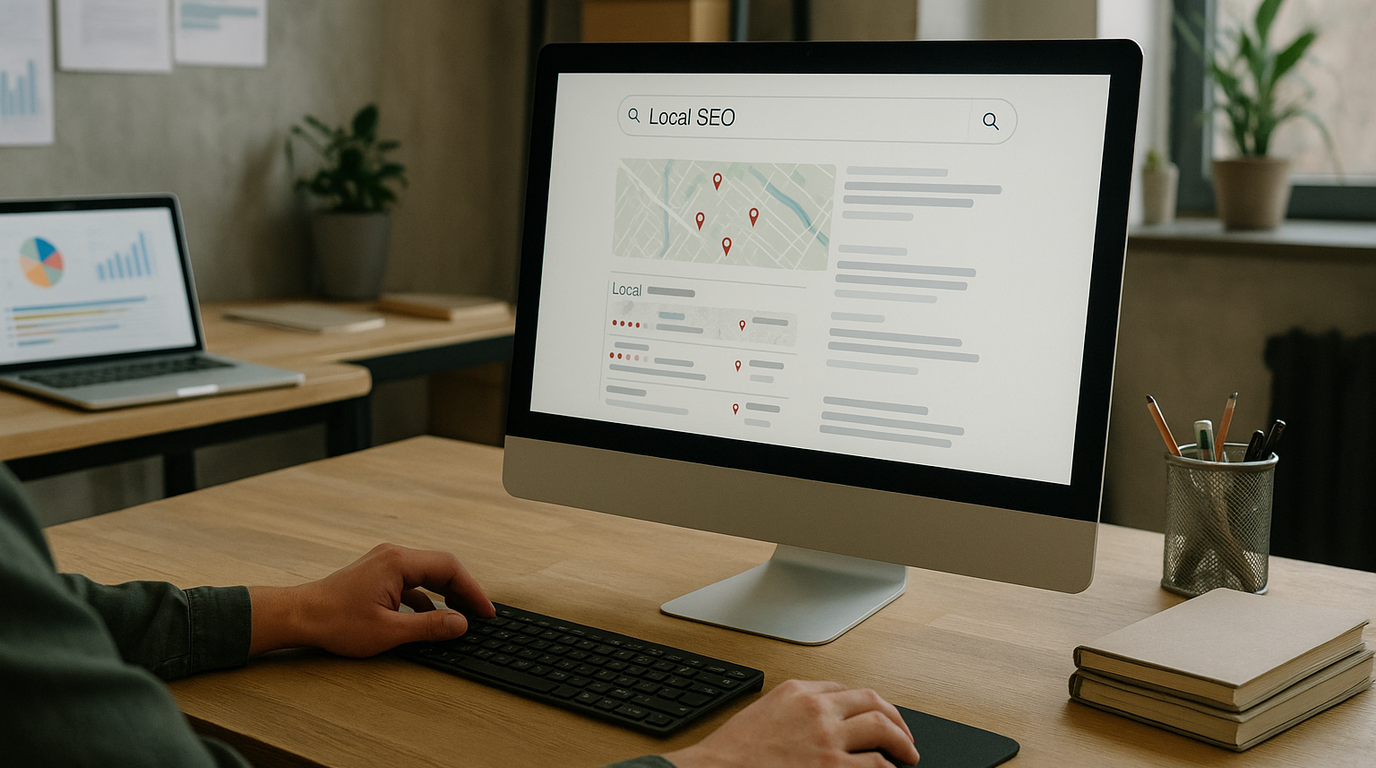
White label local SEO services let your agency sell local search work while a specialist team handles the delivery behind the scenes. The useful question is not whether outsourcing sounds efficient; it is whether the provider can protect the client relationship you worked to earn.
A bad partner creates slow work, vague reports, and awkward questions from the client. A sound one gives you a clear process, visible standards, and enough control to sell local SEO with confidence.
What white label local SEO means, in one paragraph
With white label local SEO, you sell and manage the service under your agency name, while another company performs agreed technical and content work for the local client. You keep the relationship, your brand appears on the report, and you set the end-client price; the delivery partner works as an extension of your team.
What gets delivered under the white label
Set the scope before the sale. “Local SEO” can range from a listing cleanup to ongoing work across several locations, so the tasks and approval steps should be clear.
Google Business Profile optimization
This usually covers business categories, services, areas, hours, photos, posts, and customer questions. The profile must match the real business and its priority services.
Citations and NAP consistency
Citations are business listings on directories, maps, and industry sites. NAP means name, address, and phone number, and those details should match across the web.
Local on-page SEO
Local on-page SEO improves service and location pages, internal links, page titles, and areas served. Start with the business’s real services, rather than thin city pages made only for search engines.
Review generation and management
A review process asks real customers at the right point after a job and gives the owner a simple way to respond. GatherUp reports that 92% of consumers see responses to local reviews as part of good customer service, while 82% are more likely to choose a business that actively responds.
Response quality matters as much as response speed. The same GatherUp research finds that 60% of consumers lose trust in brands using AI to respond to reviews, so an owner-approved human voice belongs in the process.
Local link building and PR
Local link building earns relevant mentions from community organizations, suppliers, trade groups, local publications, and genuine partnerships. PR supports this when there is a genuine local story.
Reporting branded as your agency
Your client should receive reporting in your agency’s name, covering completed work, meaningful movement, and next priorities. A dashboard needs context for what changed and why.
How the workflow runs from sale to monthly report
The workflow begins before you close the deal. Confirm services, service area, deliverables, and who gathers approvals, photos, access, and review-request details.
After the sale, send a structured intake with business facts, existing profiles, website access, priorities, competitors, and supportable claims.
The provider completes planned work while your agency remains the client contact. Review significant content or business-information changes before publication.
Each reporting cycle should combine completed work with a plain-English account summary. This matters because BrightLocal found that 75% of consumers decide which local business to use in under 30 minutes, and 72% look at three or fewer businesses before deciding.
White label vs hiring in-house
Hiring in-house gives you a dedicated person who learns your positioning and clients. It also means recruiting, training, management, coverage during absences, and enough client volume to support the role.
White label delivery adds specialist capacity without building a team first. It suits digital marketing agencies, web designers, PPC shops adding SEO, and solo operators who want to expand without every sale becoming a hiring decision.
The trade-off is control. An outsourced partner must earn trust through clear standards, predictable communication, and inspectable work.
How white label local SEO is priced
Price is usually a wholesale cost from the provider and a client-facing rate from your agency. The gap must cover sales, account management, revisions, tools, and difficult accounts.
Ahrefs’ SEO Pricing Survey of 439 SEO professionals puts the average local SEO cost at $1,557 per month, which is a useful market reference rather than a ready-made price list for your agency. Your floor price should be based on the real cost to service the account well, not on the lowest offer in an inbox.
Per-client retainers
A per-client retainer gives you a repeatable monthly scope and makes revenue planning easier. It works best when the client has ongoing needs such as profile upkeep, review support, content improvements, and local authority building.
Tiered packages
Tiered packages group clients by complexity, such as a simple single-location business, a more competitive market, or a company with several locations. Keep the differences visible so that sales staff and clients can see why one package needs more work than another.
What drives the price up or down
Scope changes with locations, competition, website condition, access problems, content needs, review volume, and services promoted. One price for every business often signals shallow delivery.
How to vet a white label partner before you sign
Vet the partner as carefully as someone who will speak for your agency. Ask for a sample deliverable, the intake process, and an explanation of quality checks.
Questions to ask on the sales call
- Which tasks are included every month, and which are separate projects?
- Who writes content, handles listings, and reviews the work before delivery?
- What access does the provider need, and how is that access protected?
- How are delays, approvals, and client questions handled?
- Can you review a redacted report and a sample of work from a comparable local campaign?
Listen for specific answers. Broad promises about rankings are less useful than a clear explanation of the operating process, reporting cadence, and escalation path.
Contract and communication safeguards
Your agreement should state that your agency owns the client relationship and that the provider communicates through your team unless you approve another arrangement. It should also cover confidentiality, access ownership, reporting use, notice before subcontracting, and how client data is handled when the relationship ends.
Create a communication lane before the first account starts. Your client talks to your agency; your agency uses a shared workspace or named contact at the provider; urgent issues have a defined route instead of bouncing between people.
What to do if quality drops mid-campaign
Start with the work, not the excuse. Compare delivery with the scope, document weak work, set a written correction plan, and pause new sales until the account is stable.
If the provider cannot correct the problem, take back the access and move the account using the records you kept from the start. A transparent update focused on the next actions is stronger than trying to hide a delivery failure from the client.
Where AI search fits into a white label local SEO package
AI search adds another place where a customer forms an opinion, but it does not replace the basics. Keep business facts consistent, service information clear, reviews credible, and local mentions real.
BrightLocal’s Local Consumer Review Survey reports that 45% of consumers use AI tools for local business recommendations, while 88% fact-check reviews cited by those tools. That makes accurate public information and genuine proof of service more valuable, not less.
GEO means generative engine optimization: helping AI-driven answers understand and cite a business. It extends sound local SEO through useful pages, precise details, customer evidence, and local relevance.
When white label local SEO is the wrong call
White label local SEO is the wrong call when the provider lacks a workable process, your agency cannot manage the relationship, or the client needs strategy beyond the package. It also fails when the business lacks profile access or cannot approve work.
Do not sell a service just because it fills a gap in your menu. Build the offer when you can explain the work, protect the account, and stand behind the way it is delivered.
Quick FAQ
What is white labeling? Your agency sells a service under its own brand while another company performs agreed delivery work behind the scenes.
Is white label local SEO legal? Yes, when the arrangement is honest between the businesses involved and the work follows platform rules, contract terms, and applicable law.
What does white label local SEO cost? The wholesale cost depends on scope and delivery quality, while your client price also has to cover the work your agency performs around the campaign.
Want a second set of eyes on the local SEO offer you are building or buying? Request a free audit and we will help you identify the gaps that need attention first.