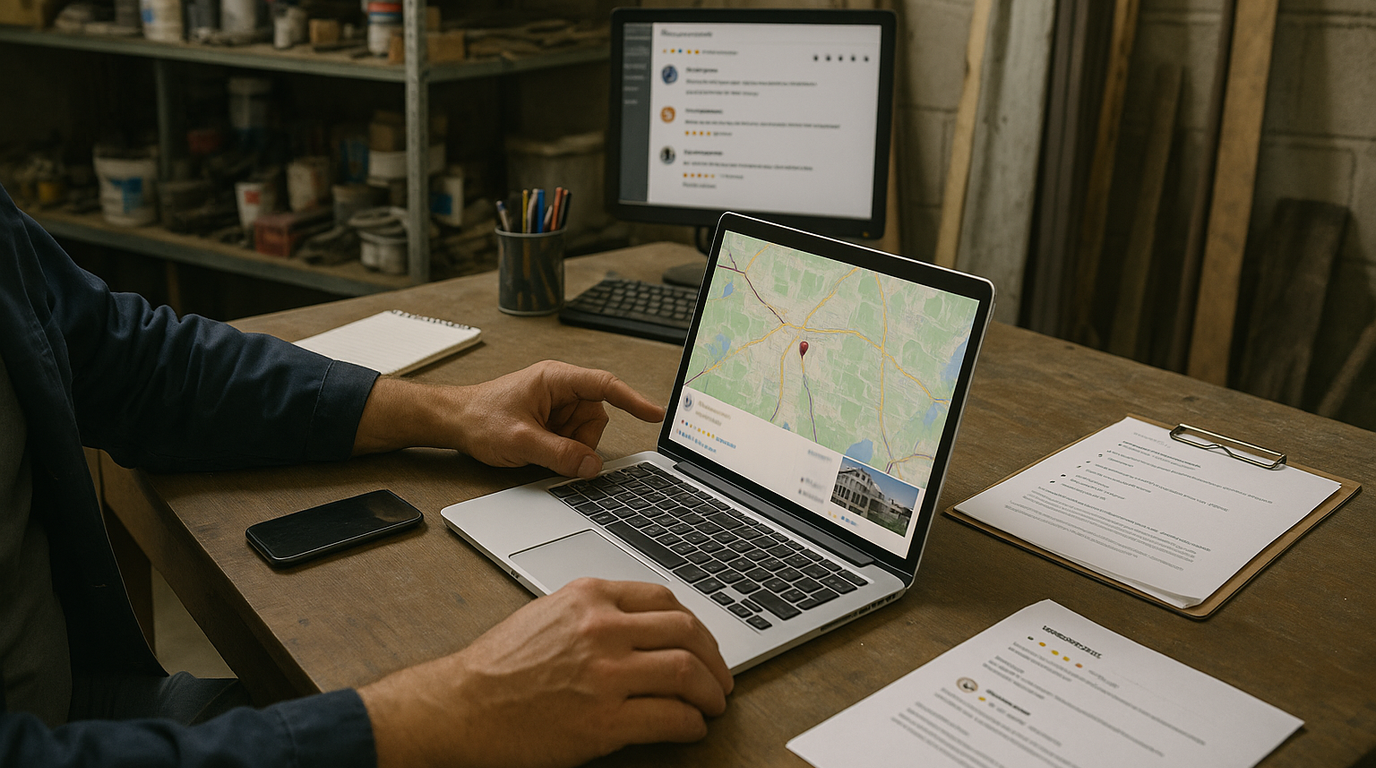
Local SEO for service area businesses begins with a hard choice: which towns deserve a page, and which are simply vanity targets. The right answer comes from profitable jobs, travel reality, and demand you can support, not from a wide circle on a map.
A long town list can make a report look active while producing poor calls. We build proof for the places where you can do good work and want more of it.
What makes an SAB different from a shop on a street corner
A service area business, or SAB, travels to the customer rather than serving them at a public walk-in location. A contractor, mobile technician, or home-service firm has to show Google and prospects where it works without pretending to have an office in every town.
Clarity matters because prospects compare quickly. BrightLocal Consumer Search Behavior reports that 75% of consumers decide which local business to use within half an hour, so a clear listing and page need to answer basic questions fast.
Set up Google Business Profile the way Google expects for SABs
Use the real business name, accurate primary category, current phone number, website, hours, and services in your Google Business Profile. Update it when coverage, hours, or services change.
Choose service areas as a practical operating map, not a wish list. Start with towns where you already complete worthwhile jobs, can arrive reliably, and have enough margin after travel.
Keep a single profile for a genuine operating business. Separate profiles belong only to separately staffed, real-world locations that can serve customers independently; extra profiles for nearby towns create confusion and can endanger the profile you rely on.
Hide the address without breaking trust
A home-based SAB can hide its street address in the public profile and show service areas instead. That protects your home while still showing customers the communities you cover.
Do not use a mailbox, virtual office, or borrowed address. Earn trust with accurate contact details, clear service descriptions, and real job photos shared with permission.
Pick the right service areas, not the most service areas
Use job history, quote requests, referrals, and route practicality to choose towns. Favor nearby areas that produce the work you want over distant names that bring poor-fit jobs.
Ask which locations generate calls for your priority services, not which locations generate the most impressions. Keep a simple lead log with town, service, and outcome, then let that evidence guide the next page.
Service area pages that earn their keep
A service area page should help a local customer understand the service, the area, and the next step. A page that only swaps one town name for another is a doorway page, meaning thin content made only to catch searches, and it adds little value.
Build pages for towns with proven demand or a clear business reason. Keep the first set small enough to improve with useful local material.
How many town pages an owner can actually maintain
The right number is the number you can keep accurate and distinct. Start with core service areas, then add a page when that town produces repeatable opportunities or supports a service you want to grow.
What goes on each page so it is not a copy of the last one
Give every page a local reason to exist. Explain service problems you see there, relevant scheduling details, and nearby work when permission allows.
Use the service and town naturally in the page title, body copy, image descriptions, and contact prompt. The core facts about your business can stay consistent, but the page should be written around that town’s needs.
Internal links and schema so Google can map your reach
Internal links connect pages on your own site. Link a town page to relevant service pages, nearby locations where useful, and your estimate page.
Schema markup is behind-the-scenes code that labels business information for search engines. Use it to identify the business, services, contact details, and coverage, but treat it as clear labeling rather than a substitute for useful content.
Reviews, citations, and local links
Reviews show a prospect how you handle real work after the job is done. GatherUp found that 85% of consumers feel some trust in online local-business reviews, making fresh, specific feedback a practical trust asset.
Ask customers consistently after completed work, without buying reviews or filtering out unhappy people. Reply in your own voice, and move problems offline for resolution.
GatherUp reports that 82% of consumers are more likely to choose a local business that actively responds to reviews. That makes a thoughtful reply part of customer service, not a task for a generic bot.
Citations are directory listings that repeat your name, address, and phone number, often called NAP. Keep those details consistent across your website, Google profile, trade directories, local chambers, and relevant neighborhood sites.
Local links should come from relevant organizations, suppliers, trade groups, community sponsorships, or earned local coverage. A worthwhile link has a real relationship behind it.
Where the phone calls actually come from
Map visibility can bring urgent nearby calls, while organic service and town pages often capture specific research searches. Separate profile actions, organic visits, estimate forms, and answered calls in reporting.
Focus on search themes that produce booked work: service plus town, urgent needs, and job types you want. BrightLocal Consumer Search Behavior says 72% of consumers look at three or fewer businesses before deciding, so qualified calls matter more than an impressive list of rankings.
Local Services Ads can complement organic SEO when they fit your category and coverage. Track paid and organic leads separately before moving budget.
Whitespark Local Search Ranking Factors notes that some personal-injury clients with strong local and organic rankings still drove 70% of cases through Local Services Ads. Your mix will have its own pattern, which is why every serious lead needs a recorded source.
A 30-minute weekly routine an owner can run without an agency
Use a short weekly block for profile upkeep. Check hours, phone, services, and photos; respond to reviews; and record the town, service, and outcome for new leads.
Then make a single improvement based on what you saw. Update a weak page, answer a repeated question, request a review after a completed job, or correct a listing.
Search Console shows Google queries and pages, the profile shows customer actions, and call tracking can identify sources. Use those records to choose the next improvement.
What a good monthly engagement looks like, and what to fire
Good local SEO is often unglamorous. It should produce profile upkeep, citation corrections, review support, page improvements, local outreach, and a plain report tied to leads.
You should see what changed, why it changed, and what comes next. Be careful with large batches of generic town pages, vague ranking screenshots, or traffic reports that never connect visits to calls and booked work.
Scope should be clear before you pay. Ahrefs’ survey of SEO professionals puts average local SEO pricing at $1,557 per month, but value depends on the work required and completed.
How long before you see real movement
Local SEO builds through accurate information, useful pages, review momentum, and local relevance. Early signals can include cleaner profile data, better query coverage, and more useful calls before rankings become steady enough to guide planning.
New domains, crowded markets, inconsistent listings, weak reviews, and distant service areas take more work. Set a baseline and judge progress by qualified leads, booked jobs, and visibility.
Expansion is earned by evidence, not by filling a map with pages.
FAQ
Do service area businesses show up on Google Maps?
Yes. A correctly configured service area business can appear in local Google results with its public address hidden.
How many service area pages does a small SAB need?
Start with towns that produce real work and that you can support with distinct information. Add pages only when demand and local proof can make each page useful.
Is Local Services Ads worth it on top of organic SEO?
It can be for eligible categories and immediate high-intent searches. Track booked jobs by source to compare paid and organic results.
Can a home-based SAB hide its address safely?
Yes. Configure the profile as a service area business, keep the home address hidden from the public listing, and use accurate service areas and contact information.
How long does local SEO take for a service area business?
It is gradual work, not a single launch event. The pace depends on the condition of your profile, website, local reputation, competition, and ongoing upkeep.
If you want a clear view of the towns, pages, and local signals worth fixing first, request a free audit.