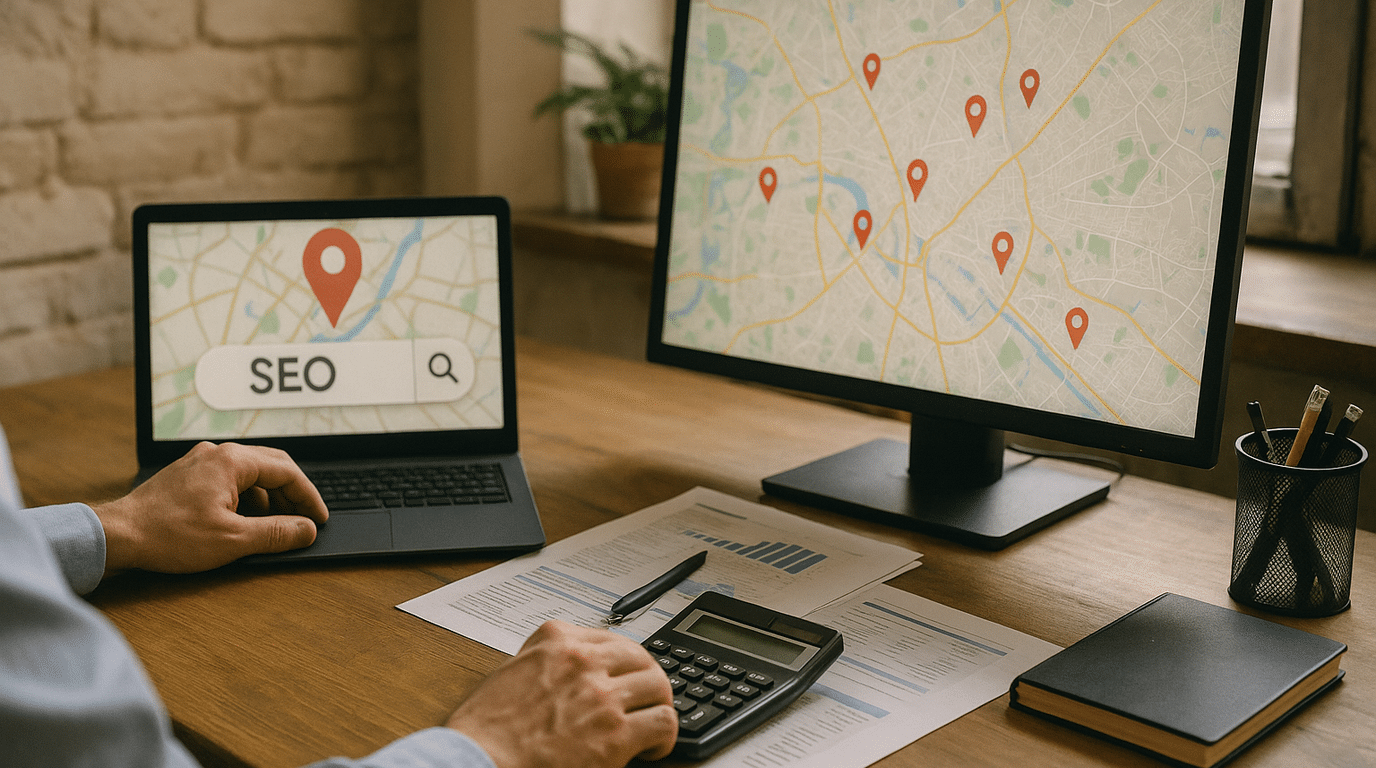
Most pages about local SEO services for accountants turn the work into a generic checklist. The real job is to help a nearby prospect confirm that your firm is qualified, reachable, relevant to their tax or bookkeeping need, and active in their area.
That takes steady work on your business profile, website, reviews, and local reputation. It also takes more care than the usual small-business playbook.
What local SEO means for an accounting firm
Local SEO helps your firm appear when someone nearby searches for an accountant, tax preparer, CPA, or bookkeeper. It covers the map results, your Google Business Profile, your website pages, directories, reviews, and the signals that connect your firm to a real place.
General SEO can reach anyone searching nationally for a broad question. Local SEO focuses on the person comparing firms in or near the places you serve.
BrightLocal Local SEO Statistics reports that 84% of consumers searched for a local business in the past 3 months. Visibility is the first step; your profile and pages also need to answer why a careful buyer should trust you.
Why accounting firms need a different local SEO approach
Accounting clients are not choosing a lunch spot. They are handing over financial records, asking questions that may affect filing deadlines, and deciding whether your firm understands their situation.
Generic city pages, stock photos, and vague claims about being the best accountant are weak material. Your local presence should show your credentials, service fit, process, location or service area, and the people behind the firm.
Trust signals matter more than for a plumber or café
Trust signals are the visible details that reduce doubt: accurate credentials, named professionals, clear services, thoughtful review responses, and useful explanations in your own voice. Keep those facts consistent across your profile, website, and directories.
Seasonality changes the calendar
Your marketing calendar should follow your working calendar. Before tax season, make core service pages and contact paths simple; after the rush, collect reviews, improve weak pages, and publish answers to questions that came up repeatedly.
The foundation: Google Business Profile and NAP
Your Google Business Profile is often the first local record a prospect sees. Complete the relevant fields, select precise categories, add current hours, write a plain description of your services, use real office photos, and keep the contact method monitored.
Setting up the profile so it actually ranks
Start with the information a client needs to verify: your legal business name, address or service-area setup, phone number, website, hours, services, and appointment path. Add updates when they help a prospect make a decision, not because a calendar says you must post.
Keeping your name, address, and phone identical everywhere
NAP means name, address, and phone number. Use the same version everywhere that matters, including punctuation, suite details, and the main phone line.
Your website: local keywords, service pages, and schema
Your website gives a prospect the fuller answer that a map listing cannot. It should load cleanly on a phone, make contact options obvious, and connect major services to the local areas where you provide them.
Choosing keywords a real client would type
Choose terms from client language, not agency jargon: “CPA in [town],” “small business tax accountant,” “bookkeeping for contractors,” or “payroll help near [town].” Use the most relevant terms naturally in page titles, headings, descriptions, and body copy.
Service-plus-town pages without thin content
Create a service-plus-town page only when it has a distinct job. Explain who the service is for, what local clients usually need, what to prepare, how you work, and how to contact the right person.
Schema markup in plain English
Schema markup is code that labels information for search engines, such as your firm name, address, phone number, services, and professionals. It helps machines interpret the facts already visible to people.
Reviews, citations, and links
Reviews and references from reputable local sources show that your firm is real and responsive. They give a prospect more than a star rating to consider.
Getting reviews from clients who never log in
Make the request easy and timely. After a completed engagement or a positive conversation, send a short personal email or text with one direct review link and a simple prompt about the service used.
GatherUp found that 92% of consumers see owner responses to local reviews as part of good customer service, and 82% are more likely to choose a business that actively responds. Reply as a person, protect client privacy, and take sensitive details off the public thread.
Citations worth chasing and ones to ignore
A citation is an online mention of your firm, usually with its NAP details. Prioritize Google, established accounting and professional directories, your state society where relevant, local chambers, and trustworthy local business listings.
Content that brings in local clients
Topics that match what people actually search
Write about decisions a nearby owner or individual is already trying to make: choosing a bookkeeping workflow, preparing for estimated taxes, organizing records before an appointment, or deciding what to bring to a tax consultation. Add local context only where it changes the answer.
BrightLocal Local SEO Statistics reports that 75% of consumers decide which local business to use in under 30 minutes, while 72% look at three or fewer businesses. Clear answers make that comparison easier.
What to publish during quiet months
Use quieter periods to update foundational pages, turn recurring client questions into articles, check your profile, and request feedback from completed work. Build a short publishing list from emails, intake calls, and client meetings.
How long it takes and what it costs
Local SEO moves in stages. The opening work is usually correcting profiles, tracking search terms, repairing website basics, and deciding which services and locations deserve dedicated pages.
A realistic timeline for a one or two-partner firm
Then publish priority pages, improve citations, collect reviews, and watch what queries and calls appear. Later work should build on the questions prospects ask and the services that create good-fit leads.
What drives the price up or down
Price depends on the condition of your website and listings, the number of offices or service areas, local competition, content needed, technical repairs, and who supplies approved subject-matter input. A clear scope matters more than a low starting quote.
Ahrefs SEO Pricing Survey reports local SEO averaging $1,557 per month, based on responses from 439 SEO professionals. Use that as a market reference, then compare the actual work, reporting, access, and accountability in a proposal.
What to keep in-house versus hand to an agency
Keep client judgment, technical accuracy, credential details, approval of service claims, and review responses with sensitive facts in-house. Your team knows the boundaries of the work and wording that fits your firm.
Measuring whether it is working
Track business outcomes before vanity metrics: qualified calls, booked consultations, contact-form inquiries, direction requests if you have an office, and which services create the best-fit leads. Tag or ask each new lead how they found you, then review the notes with website and profile data.
Also track NAP accuracy, review activity, the search terms that trigger your profile, page engagement, and rankings in locations that matter. If a previous agency underperformed, ask for access to your accounts, a list of changes made, and a plain explanation of what each change was meant to improve.
AI search changes the presentation, not the core task. BrightLocal Local Consumer Review Survey reports that 45% of consumers use AI tools for local business recommendations and 88% fact-check reviews cited by those tools; accurate, specific public information gives people and systems better material to evaluate.
FAQ
How much do local SEO services cost for an accounting firm?
Ahrefs SEO Pricing Survey reports a local SEO average of $1,557 per month. Your scope depends on the firm’s existing site, locations, listings, competition, and content needs.
How long does local SEO take to bring in new clients?
Start by fixing the foundation, then build pages, reviews, and local references over the following months. The timeline depends on the competition and how much credible information the firm already has online.
Can a small accounting firm do local SEO without an agency?
Yes. A small firm can keep its profile accurate, request reviews, update core service pages, and track inquiries, then bring in specialist help for technical work or a larger cleanup.
What is the single biggest local SEO mistake accountants make?
Using generic copy that could describe any firm is the biggest mistake. Specific services, local relevance, real credentials, and accurate business details give a prospect a reason to contact you.
Does local SEO still matter with AI search results?
Yes. AI tools pull from public information, and local buyers still need reliable details about your firm, services, reputation, and location before they contact you.
If you want a clear view of what is helping and what is holding your firm back, request a free local SEO audit.